

When an SME decides to create or redesign its website, the question of technological choice always comes up: should it opt for an open source CMS, a proprietary SaaS-type builder, or a custom solution?
For over 20 years, WordPress has set the global standard for content management systems. In 2026, it still powers more than 40 % of the world's websites, according to statistics from W3Techs, which continuously measures the use of web technologies.
This dominance is not the result of chance or a simple effect of seniority. It is based on strategic fundamentals that respond precisely to the constraints of the SMES The key factors are: limited budget, need for autonomy, scalability, visibility on Google and long-term cost control.
In this article, we'll take an in-depth look at why WordPress is still the most rational and strategic solution for small and medium-sized businesses.
1. Global leadership to secure your investment
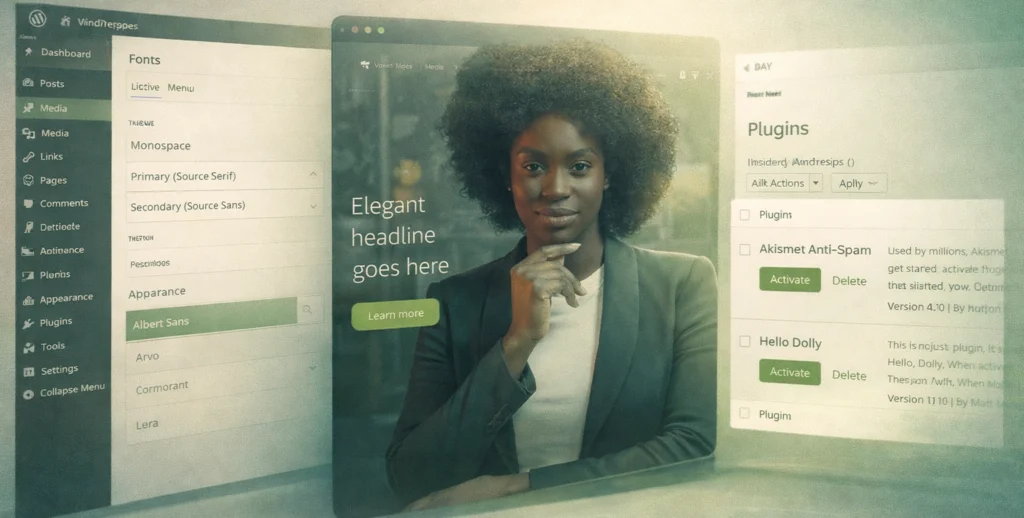
Choosing a technology isn't just about choosing a tool. It's about choosing an ecosystem.
WordPress is used by millions of businesses, freelancers and major organizations. This massive adoption guarantees :
An active community
- Regular updates
- Ongoing safety
- A wealth of documentation
- Near-universal availability of developers
According to W3Techs, WordPress represents around 62 % of market share among the CMS identified. This means that out of every 10 sites using a CMS, more than 6 use WordPress.
For an SME, this considerably reduces technological risk. You're not dependent on a fragile startup or a proprietary tool that may close tomorrow.
It's a choice of strategic stability.
2. An open source solution = total freedom
WordPress is open source software.
This means:
- You own your site.
- You own your data.
- You can change providers without losing your platform.
- You're not locked into a mandatory technical subscription.
The project is being maintained by WordPress Foundation, This guarantees community-based, non-commercial governance.
For an SME, this represents a major advantage over closed solutions where :
- You rent your site.
- You pay for life.
- Advanced features are locked behind subscriptions.
With WordPress, you invest in a digital asset that you actually control.
3. Lower total cost of ownership over the long term
Many entrepreneurs focus on the initial price.
But the real question is: how much will your site cost in 3 to 5 years?
With WordPress :
- The software is free of charge.
- Professional themes cost between €0 and €100.
- Essential extensions are often free.
- Hosting can start at less than €10/month.
Conversely, SaaS solutions charge :
- Mandatory monthly subscription
- Additional costs for e-commerce
- Transaction fees
- Recurring premium modules
Over 5 years, an SME can save several thousand euros.
WordPress lets you invest in growth rather than fixed costs.
4. Incomparable flexibility
An SME is evolving. Today, it wants a showcase site. Tomorrow, it will want :
- A blog
- A reservation system
- An online store
- A member's area
- An LMS
- A marketplace
With WordPress, anything is possible thanks to its ecosystem of extensions.
For e-commerce, the WooCommerce transforms a site into a complete store.
WooCommerce is one of the most widely used e-commerce solutions in the world.
Unlike many platforms, you can start simple and gradually evolve without having to migrate to another system.
5. Exceptional SEO power
Visibility on Google and other search engines is crucial for SMEs.
WordPress is designed with an SEO-friendly structure:
- Own URLs
- Fine-tuned tag management
- Optimizing permalinks
- Mastering metadata
- Full compatibility with SEO best practices
Extensions such as Yoast SEO or Rank Math facilitate technical optimization.
According to Search Engine Journal, WordPress is one of the most SEO-friendly CMS on the market, thanks in particular to its customizable structure.
For a local or national SME, this is a major competitive advantage.
6. Native mobile adaptability
Google favors mobile-first indexing.
The majority of modern WordPress themes are :
- Responsive
- Optimized for mobile
- Core Web Vitals compatible
Tools such as Google PageSpeed Insights for easy performance testing. A SMES can no longer afford a slow or poorly optimized site on smartphones. WordPress makes it possible to achieve high scores with the right configuration.
7. Controllable safety
An argument often used against WordPress is security.
In reality, WordPress is secure as long as it's properly configured and maintained.
The majority of faults originate from :
- Obsolete extensions
- Pirated themes
- Low-end accommodation
- Bad practices
Tools such as Wordfence considerably enhance safety.
Regular updates to the WordPress core actively correct vulnerabilities. Security isn't a technological issue. It's a management issue. Find out more today our web management offer.
8. Strategic autonomy for SMEs
One of WordPress' greatest assets is its intuitive interface.
An executive can :
- Publish an article
- Edit text
- Add an image
- Create a page
- Manage your products
Without systematically depending on a developer. He can also delegate this task to an employee or simply to a member of his team not necessarily trained in a complex system. This reduces costs and speeds up marketing actions. For a SMES dynamic, this autonomy is decisive.
9. Universal compatibility with modern tools
10. An ideal solution for content marketing
The blog is native to WordPress. For a small business that wants to :
- Attracting traffic
- Position yourself as an expert
- Generate leads
- Improve your referencing
WordPress offers an optimal environment. It is historically a publishing platform. Content marketing is built into the very DNA of the CMS.
11. A global community
Thousands of developers contribute to the project. WordCamps« events are organized all over the world.
This vitality guarantees :
- Continuous innovation
- Community support
- Dynamic ecosystem
Few proprietary solutions can match this network effect.
12. Unlimited scalability
An SME can start with :
- Shared hosting
Then move on to :
- VPS
- Cloud
- Dedicated infrastructure
Without changing platforms, and sometimes without changing providers. WordPress grows with you. This is a crucial point.
13. WordPress versus the alternatives
Platforms such as :
- Wix
- Squarespace
- Shopify
are attractive for quick start-ups.
However :
- They lock you into a proprietary ecosystem.
- Costs rise with growth.
- Advanced customization becomes limited.
WordPress remains more flexible in the long term.
In 2026, WordPress isn't just «still relevant».
It remains the most rational solution for SMEs seeking :
- Freedom
- Scalability
- SEO Performance
- Cost control
- Autonomy
- Controlled safety
Its global dominance, open source model and ecosystem make it a de facto standard. For an ambitious SME, choosing WordPress is not a default choice. It's a strategic choice.
 French
  English