
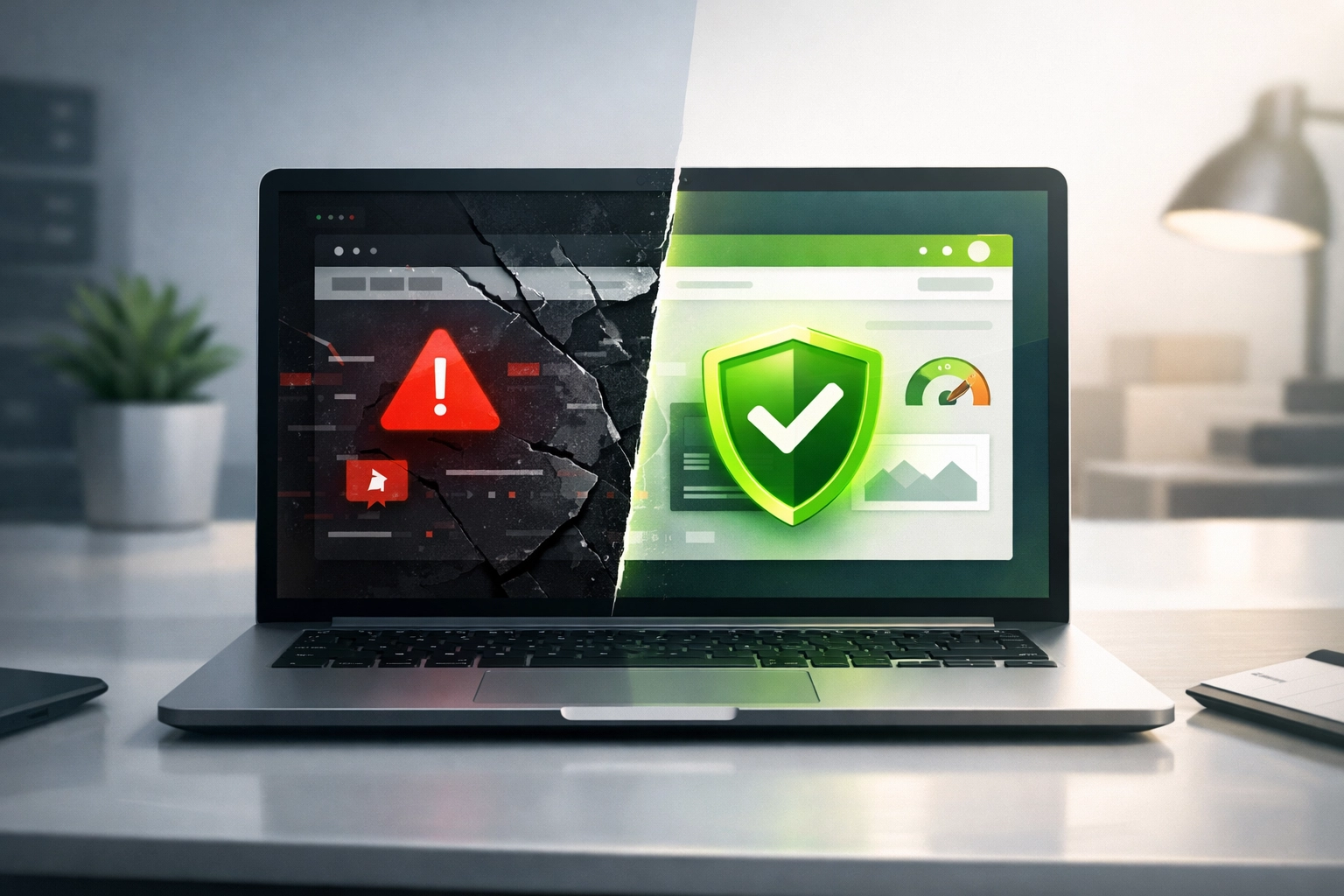
Creating a website is a strategic step.
But leaving it unmaintained is a costly mistake.
Many entrepreneurs think of a website as a printed brochure. Once online, it « turns on its own« . In reality, a website is a living system.
It relies on evolving technologies, servers exposed to the Internet, extensions developed by third parties, and constantly changing security standards.
A site without maintenance is not stable. It's on borrowed time.
In this article, we'll look at why lack of maintenance gradually turns a digital asset into a risky liability, and how to avoid this.
1. A website is software, not a poster
A modern website is built on several technical layers.
- The hosting server.
- The operating system.
- Language (PHP, Node, etc.).
- CMS (like WordPress).
- Themes and extensions.
- The database.
Each layer evolves.
Take the example of WordPress. It powers over 40 % websites worldwide. But it regularly releases security and compatibility updates. Plugins do the same.
If you don't update anything for 6 or 12 months, you create a gap between your site and current standards.
And this gap becomes a gateway.
2. Risk number 1: piracy
An unmaintained site is an easy target.
Automated attacks scan the Internet for known vulnerabilities. They don't target «you». They target vulnerabilities.
According to the Sucuri, Many of the pirated sites featured obsolete versions of CMS or extensions.
The problem is simple.
When a vulnerability is discovered, it is made public. A patch is released. If you don't update, your site remains exposed to a flaw that is now known to everyone.
It's like leaving the key under the mat after announcing the address on a public sign.
3. The invisible risk: gradual deterioration
Not all hazards are spectacular. Sometimes, the site doesn't «crash». It slows down. It displays minor errors. Some features stop working. Forms no longer transmit emails correctly.
Gradually, the user experience deteriorates.
Google measures these signals.
The 4 main Core Web Vitals have become an important criterion for assessing a site's quality. A slow or unstable site loses visibility.
An unmaintained site becomes slower for several reasons:
- Conflicts between versions.
- Obsolete extensions.
- No server optimization.
- Unnecessary data accumulation.
The owner is often unaware of this until conversions drop.
4. The SEO risk: losing what you've built
Search engine optimization is a long-term investment.
It can be destroyed within a few weeks.
A hacked site can be flagged as dangerous in Google results. Visitors then see a warning message.
Google Safe Browsing explains this mechanism here : https://safebrowsing.google.com/
Infection can cause :
- Spam link injection.
- Adding fraudulent pages.
- Redirections to malicious sites.
Result loss of confidence, drop in traffic, damaged reputation.
And even after cleaning, it can take months to return to normal.
5. Updates also correct functional bugs
Maintenance is not just about safety.
She corrects:
- Browser incompatibilities.
- Mobile display errors.
- Payment problems.
- Bugs on forms.
Imagine an online store whose payment module stops working after a browser update.
Without maintenance, no one notices immediately.
Every day without correction = lost sales.
6. Standards are constantly evolving
The web is not static.
Security, confidentiality and accessibility requirements are evolving.
For example, the European regulation RGPD has profoundly changed the way personal data is managed.
Even if you're not based in Europe, you can still collect data from European users. A non-maintained site can become non-compliant. This can lead to legal and reputational risks.
7. Hosting compatibility
Web hosts regularly update their technical environments. A new version of PHP may be activated. An older site may then become incompatible. PHP publishes its life cycles here: https://www.php.net/supported-versions.php
When your version is no longer supported, it no longer receives security patches.
You're faced with a choice: upgrade in a hurry, or risk incompatibility and exposure.
In both cases, the cost will be higher than if maintenance had been regular.
8. Backups: your life insurance
Maintenance includes setting up automatic backups, because a site without a backup is vulnerable to human error, hacking, mishandling or server problems, and without a recent backup recovery may become impossible; in cybersecurity, the basic rule is the 3-2-1 principle - 3 copies of data, 2 different media, 1 copy off-site - explained in detail. here.
Without a clear strategy, you are literally gambling with your digital assets.« save money« But the calculation is biased, because the cost of annual maintenance is predictable, whereas the cost of a hacked site is unpredictable:
- technical cleaning, loss of traffic, loss of customers, downtime, legal risk
- and according to many cybersecurity professionals, remediation often costs several times more than prevention, which is a universal principle of risk management.
10. Brand image and performance are directly impacted
A slow, broken or infected site immediately sends out a message of lack of professionalism and rigor, even if your service is excellent. And yet, the website is often the first point of contact with your prospects. A study from Stanford University shows that perceived credibility is highly dependent on the quality of the design and the site itself.
What's more, performance directly influences conversion. Google has shown that loading speed has a significant impact on conversion rates.
An unmaintained site progressively slows down and ends up degrading SEO, conversion and brand perception.
11. Maintenance is strategic, not just technical
Maintenance is not limited to updates. It includes continuous optimization, data analysis, adaptation to new uses and vulnerability prevention. Attacks are becoming more and more automated, as the annual report from ENISA;
In environments like WordPress, where many vulnerabilities come from extensions, regular monitoring is essential to avoid conflicts, flaws and instability. The difference is clear: corrective maintenance suffers problems; preventive maintenance avoids them. Mature companies opt for prevention, because a website is not a passive tool; it's a strategic asset that must evolve with the company.
Conclusion: digital neglect is not neutral
A site without maintenance doesn't remain «stable». It degrades silently.
Every update you ignore widens the gap between your site and current standards. Every uncorrected flaw increases your exposure. Every second of slowness reduces your conversion. Every undetected bug weakens your credibility.
The question is not «Is something going to happen?»; the question is «When?»
Today, the web is a hostile environment by default. Attacks are automated. Technologies are constantly evolving. Users are demanding. Search engines measure everything. An unmaintained site gradually becomes :
- More vulnerable
- Slower
- Less credible
- Less visible
- Less profitable
And the most dangerous thing is that this degradation is invisible... until the day it isn't.
- A hack.
- A sharp drop in traffic.
- An offline site.
- A loss of customers.
At that point, maintenance becomes urgent. And what could have been controlled becomes a crisis. Strategic companies don't operate on the basis of reaction. They operate on anticipation.
Maintenance is not a technical option.
It's a management discipline.
It's asset protection.
It's reputational insurance.
It's a digital maturity decision.
At VINADOU, We don't just build sites. We build sustainable digital infrastructures. Because a website doesn't just have to exist.
- He has to perform.
- It needs to evolve.
- It must be protected.
Above all, it must never become a silent risk.
 French
  English