

Creating a website is no longer an option. It's a must.
But one question always comes up among entrepreneurs, freelancers and SMEs:
which type of site to choose?
- A showcase site?
- An e-commerce site?
- A landing page?
Creating a website today is no longer simply a matter of «having an online presence».
It's all about choosing the right strategic tool to achieve a specific objective.
Many entrepreneurs ask themselves the same question: should I have a showcase site, an e-commerce site or a landing page?
The answer depends less on technology than on your business model, maturity and acquisition strategy.
In this article, we take an in-depth look at the differences, advantages, limitations and use cases of each format.
The objective is simple: to enable you to make a rational decision, in line with your business objectives.
Understanding the real issue: objective before format
Before we even talk about design or functionality, let's make one thing clear:
- A website isn't an aesthetic object, it's a conversion tool.
- The main purpose of a showcase site is to provide information and credibility.
- The aim of an e-commerce site is to sell directly.
- A landing page aims to convert on a specific action.
The first strategic error is to choose a format because it's «fashionable» or because the competition is using it.
The right choice depends on your offer, your sales cycle and your acquisition strategy.
The showcase site
Definition
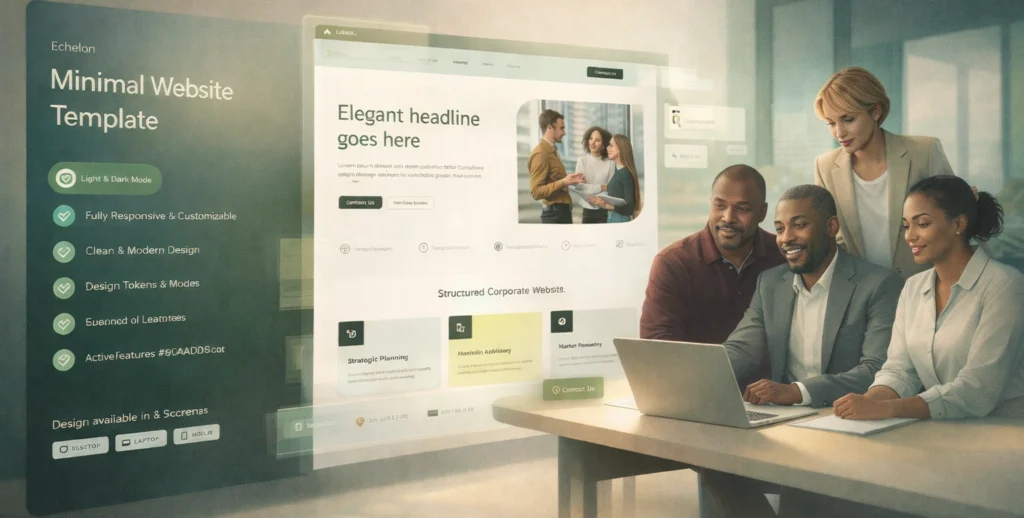
A showcase site is a website whose main objective is to present a company, its services, expertise and contact details.
He doesn't sell directly online (in most cases).
It serves to reassure, inform and generate contacts.
What's the real purpose of a showcase site?
A showcase site fulfills several strategic functions:
- Enhancing credibility
- Present an offer in a structured way
- Improve search engine visibility
- Generate quote requests or contacts
According to a Stanford Persuasive Technology study Lab, 75 % of Internet users judge a company's credibility on the basis of its website.
This means that a well-designed showcase site directly influences the perception of trust.
Typical structure of a showcase site
A showcase site generally includes :
- A home page
- An About page«
- A services page
- A contact page
- Possibly a blog
It can be built with a CMS like WordPress, which powers over 40 % websites worldwide according to W3Techs.
- Advantages of a showcase site
A showcase site is ideal when :
- You offer personalized services
- Your sales cycle requires a human exchange
- Your goal is lead generation
- You want to work on your SEO over the long term
It's simpler, cheaper and more flexible than e-commerce.
- Limits of the showcase site
A showcase site does not :
- Sell automatically
- Manage native online payments
- Fully automate the sales tunnel
If your model is based on direct transactions, this format quickly shows its limitations.
The e-commerce site
Definition
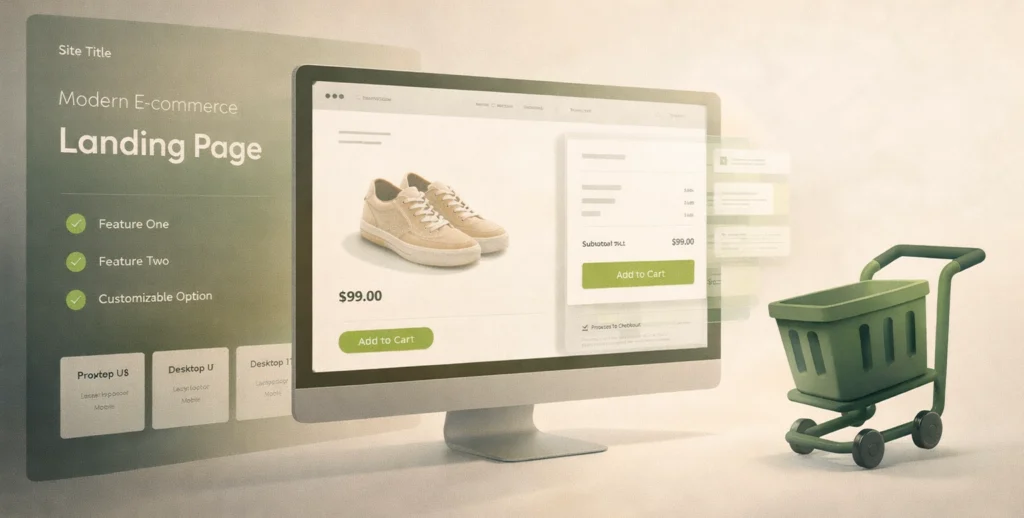
An e-commerce site is a platform for selling products or services directly online, with shopping cart, secure payment and order management.
He doesn't sell directly online (in most cases).
It serves to reassure, inform and generate contacts.
The scale of the e-commerce market
Online business is growing steadily.
According to Statista, Worldwide e-commerce sales have exceeded $5,000 billion and continue to grow every year.
This shows that e-commerce is no longer a marginal option, but a major channel.
Typical e-commerce site structure
An e-commerce site generally includes :
- Home page
- Product catalog
- Product data sheets
- Basket
- Payment tunnel
- Customer account
Solutions like WooCommerce or Shopify allow these infrastructures to be created without complex development.
- Advantages of an e-commerce site
The main advantage is automation.
You can sell 24 hours a day, without direct human intervention.
The system handles payments, confirmations and sometimes even invoicing.
E-commerce also makes it possible :
- Precise sales analysis
- Conversion optimization
- Retargeting
- Marketing automation
- E-commerce site limits
E-commerce requires :
- Solid logistics
- Structured customer service
- An acquisition strategy that pays off
- More complex technical management
It's more expensive to set up and maintain than a showcase site.
What's more, according to Baymard Institute, The average cart abandonment rate is around 70 %.
The landing page
Definition
A landing page is a single page designed to encourage a specific action: registration, download, reservation, purchase, making an appointment.
It eliminates distractions and focuses attention on a single objective.
Why do landing pages convert better?
Landing pages reduce friction.
According to HubSpot, companies that increase their number of landing pages see a significant increase in leads.
The principle is simple: the clearer the intention, the higher the conversion.
Typical landing page structure
An effective landing page includes :
- A profit-oriented stock
- A clear value proposition
- Social proof
- A strong call to action
- No distracting navigation menus
- Benefits of landing pages
Ideal for :
- Launch an advertising campaign
- Test an offer
- Validating a contract
- Promoting a unique product
- Generate leads quickly
It's quick to deploy and highly optimizable.
- Limits of the landing page
It does not replace :
- A long-term SEO strategy
- A structured site
- A complete platform
It's effective in a specific context, but not enough on its own to build a lasting brand.
Our approach
At VINADOU, We never start with technology.
We start with your business model.
Every digital project is based on a central question:
what does your website really need to do?
Our conviction
There is no such thing as the «best type of site».
There's a digital architecture to suit your ambitions. We build scalable structures capable of :
- Generate leads
- Convert efficiently
- Adapting to growth
- Maximizing return on investment
A website must be a performance lever.
Not just an online presence.
How do I know whether I need a showcase site, an e-commerce site or a landing page?
First, we analyze your business model, sales cycle and growth objectives.
If your business is based on personalized services or a decision-making process involving human interaction, a structured showcase site is often the strategic foundation.
If you sell standardized products or services that can be digitized, an e-commerce architecture makes sense.
If your aim is to test an offer, launch a campaign or generate leads quickly, a targeted landing page will perform better.
The choice is never aesthetic.
It's always strategic.
Can several formats be combined on the same project?
Yes, and it's often the most effective solution.
A showcase site can include :
- An e-commerce section to sell certain products
- Landing pages dedicated to marketing campaigns
- An SEO-optimized blog to generate qualified traffic
The strongest companies don't choose a format.
They build a scalable architecture.
What is the VINADOU method for structuring a web project?
Our approach is based on three stages:
1. Strategic clarification
Analysis of business model, margins, acquisition sources and conversion targets.
2. Adapted architecture
Choice of main format (shop window, e-commerce or hybrid) and possible integration of specific landing pages.
3. Continuous optimization
Progressive improvement in conversions, SEO and user experience.
We see a website as a digital asset, not just a graphic showcase.
Is it risky to start with a single landing page?
It all depends on your objective.
To test a product or validate a market, a landing page is often all you need.
On the other hand, to build a sustainable brand, it will be necessary to gradually integrate a more complete structure.
At VINADOU, We favor evolutionary strategies: start simple, structure progressively, scale intelligently.
What's the most common mistake?
Choose a format before clarifying your strategy.
E-commerce without acquisition becomes a cost.
A showcase site without optimization becomes invisible.
A landing page without traffic converts nothing.
Technology never makes up for a lack of strategy.
 French
  English