

In 2026, not having a professional website is a handicap.
But having a bad website is worse.
A site that's slow, poorly structured, not mobile-optimized or invisible on Google doesn't just «pay for itself»: it destroys your credibility, weakens your brand and drives away potential customers.
The real question is: Is your site working for you... or against you?
In 2026, the amateur "showcase site" is a liability
A poorly structured site:
- destroys your credibility,
- scares off your visitors,
- blocks your referencing,
- reduces your conversions,
- exposes your company to technical risks.
According to Google (research on Core Web Vitals and user experience), the probability of a user leaving a mobile site increases drastically when loading time exceeds 3 seconds.
On his side, HubSpot regularly points out that the majority of visitors judge a company's credibility by the design and experience of its site.
In other words Your website is your first sales tool.
In this article, we take an in-depth look at the 10 major mistakes to avoid, with current best practices.
1. Creating a site without a clear business objective
The mistake is to create a site «to be present online».
Without :
- Main objective,
- Conversion tunnel,
- Priority action.
A professional website must answer a strategic question: What specific action do you want the visitor to take?
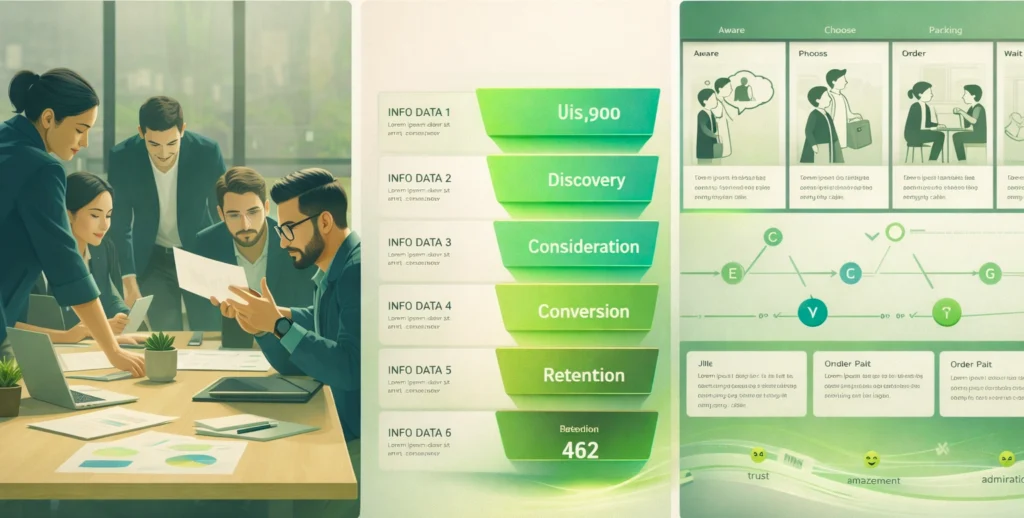
A funnel, or conversion tunnel, is the strategic path a visitor follows from brand discovery to final action (purchase, registration, appointment, etc.).
It's called a «funnel» because :
- Many people enter at the start
- Few reach the final stage
- Each stage naturally filters out prospects
Before you even think about design or to tools, The creation of a professional website begins with a rigorous strategic diagnosis.
This involves analyzing your current positioning, clarifying your value proposition, defining measurable objectives (visibility, lead generation, sales, authority) and precisely mapping the customer journey, from discovery to conversion.
Without this step, the site remains a simple showcase; with it, it becomes a real growth driver. This is precisely the aim of our Strategic coaching 1:1 To help managers structure their digital presence as a business asset, aligned with their vision, margins and long-term ambitions.
2. Ignore Mobile-First

Since Google introduced indexing Mobile-First, it's the mobile version of your site that serves as the reference for SEO evaluation.
Design first on desktop then «adapt» The right approach is to think mobile right from the design stage: structure shorter, clearer sections, visually prioritize essential information, lighten the weight of images, remove superfluous scripts and optimize loading for a real 4G connection - not desktop fiber.
During a strategic website audit, the mobile experience must be a priority: immediate readability, clear calls to action, technical performance and impact on the mobile bounce rate are decisive indicators for visibility and conversion.
3. Neglecting loading speed

Google recommends optimizing :
- LCP (Largest Contentful Paint)
- CLS (Cumulative Layout Shift)
- INP (Interaction to Next Paint)
As key signals of the user experience.
In 2026, ignoring the Core Web Vitals is tantamount to deliberately sabotaging your site's performance.
However, overloaded low-cost hosting, uncompressed images, an accumulation of poorly optimized plugins or an overly heavy theme directly degrade these metrics.
Result This means longer loading times, visual instability, slower interactions - and therefore loss of positioning, higher bounce rates and lower conversions. Technical performance is not a technical detail: it's a strategic lever for credibility and profitability.
Structured companies never consider their website as a «finished» project, but as a strategic asset to be constantly maintained.
They implement monthly technical maintenance (updates, security, backups), ongoing optimization (improved performance, SEO, conversions) and regular monitoring of key indicators to anticipate problems before they impact the business.
This is precisely the aim of our maintenance and optimization service ongoing: protect your digital investment, guarantee its performance over time, and prevent your site from slowly degrading to the point where it becomes a brake rather than a lever for growth.
4. Post-creation SEO
It's a common mistake to think of SEO as just another layer to be added once the site is complete. You finalize the design, validate the texts, publish the site... and then you wonder how to »integrate SEO«.
This approach is structurally inefficient. SEO is not something that can be grafted onto an existing site: it has to be designed from the outset.
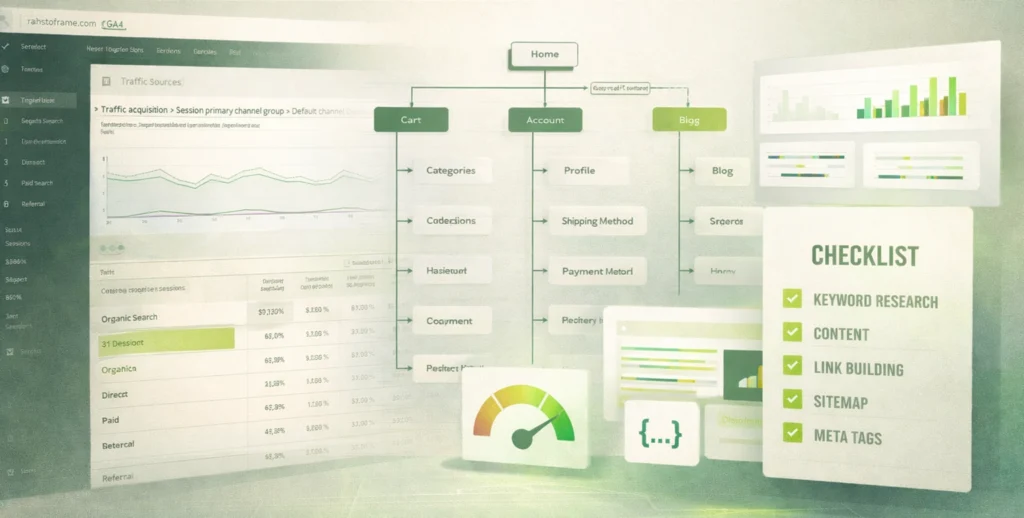
The SEO Starter Guide Google's official search engine optimization guidelines make it clear: structure, content comprehension by search engines and the quality of the user experience are fundamental right from the site design stage. In other words, if your tree structure is poorly thought out, if your pages don't correspond to your prospects« actual search intentions, or if your tags are inconsistent, no amount of »after-the-fact optimization" will fully correct the problem without a redesign.
A professional website must therefore start with a strategic reflection on keywords, pillar themes and content hierarchy. This involves identifying the queries actually typed by your potential customers, structuring main pages around these intentions, and then creating a logical internal mesh.
This architecture enables Google to understand your expertise and position it correctly.
Make the SEO after creation is often like rebuilding an already finished house and modifying its foundations. Conversely, integrating SEO right from the planning phase transforms your site into a lasting asset, capable of generating qualified traffic over the long term. It's precisely this difference that separates a simple « online » of a real site strategic.
5. Confusing design

Confusing design is one of the most costly mistakes in 2026. Not because it's «ugly», but because it creates friction. And friction kills conversion.
Many sites accumulate blocks, colors, animations and buttons. Each element seems individually justified. Together, they become permanent visual noise.
The modern user scans a page in a matter of seconds. If they don't immediately understand what you're offering and what they need to do, they leave. This behavior is well documented in UX research.
The Nielsen Norman Group reminds us that clarity, consistency and simplicity are fundamental principles of usability:
- Effective design guides attention. It prioritizes information. It highlights one main message per section. It reduces choices to facilitate decision-making.
- Simplicity is not a lack of sophistication. It's a strategy. A professional website doesn't seek to impress through complexity. It seeks to convert through clarity.
- A clean design, aligned with your positioning and designed for conversion, transforms your site into a strategic tool. A confusing design, on the other hand, turns your traffic into lost opportunities.
6. Lack of credibility
Credibility is a decisive factor in 2026. A visitor judges your seriousness in a matter of seconds. Even before reading your arguments, they're subconsciously assessing your reliability.
The Stanford Web Credibility Project has shown that the visual appearance and structure of the site strongly influence the perception of trust:
- A poorly structured, dated or approximate site immediately creates doubt. Even if your service is excellent, a first impression can be enough to turn a prospect away.
- Credibility is based on several concrete elements. Real, professional photos reinforce authenticity. Verifiable testimonials provide social proof. Clear contact information reduces uncertainty.
Security also plays a central role. The presence of HTTPS and a visible SSL certificate reassures the user. Conversely, a security warning instantly destroys trust.
A professional website doesn't leave credibility to chance. It builds it intentionally. Every detail - visual, textual and technical - must confirm that the company is serious, structured and reliable.
In a competitive environment, trust is not a bonus. It's a condition of entry.
6. Lack of credibility

Credibility is a decisive factor in 2026. A visitor judges your seriousness in a matter of seconds. Even before reading your arguments, they're subconsciously assessing your reliability.
The Stanford Web Credibility Project has shown that the visual appearance and structure of the site strongly influence the perception of trust:
- A poorly structured, dated or approximate site immediately creates doubt. Even if your service is excellent, a first impression can be enough to turn a prospect away.
- Credibility is based on several concrete elements. Real, professional photos reinforce authenticity. Verifiable testimonials provide social proof. Clear contact information reduces uncertainty.
Security also plays a central role. The presence of HTTPS and a visible SSL certificate reassures the user. Conversely, a security warning instantly destroys trust.
A professional website doesn't leave credibility to chance. It builds it intentionally. Every detail - visual, textual and technical - must confirm that the company is serious, structured and reliable.
In a competitive environment, trust is not a bonus. It's a condition of entry.
7. Neglecting safety

Website security is often invisible... until it becomes a problem. Many companies regard protection as a secondary technical detail. In reality, it's a strategic pillar.
The most critical vulnerabilities are documented by the’OWASP Top 10, the international benchmark for application security :
These include injections, authentication flaws, access mismanagement and configuration errors. These vulnerabilities are not confined to large corporations. The sites of SMEs and the self-employed are regularly targeted, precisely because they are less protected.
The most common mistake is to install unmaintained or pirated themes or plugins. In the short term, this seems economical. In the medium term, it's a major risk. An obsolete component can become a gateway.
Regular updates are essential. They correct publicly identified vulnerabilities. Ignoring them means leaving a known vulnerability open to all.
Security also includes automatic backups, reinforced authentication (such as double authentication) and the use of a valid SSL certificate. A single incident can result in data loss, site unavailability or damage to your reputation.
A hacked site doesn't just lose traffic. It loses trust. And trust, once broken, is hard to rebuild.
8. Launch the site... then abandon it
Many entrepreneurs invest time and money in creating their site. Launch day is seen as the end of the line. In reality, it's just a starting point.
A professional website is not a one-off project. It's an evolving asset. If left unattended, it will gradually deteriorate, with declining performance, obsolete content and stagnant conversion rates.
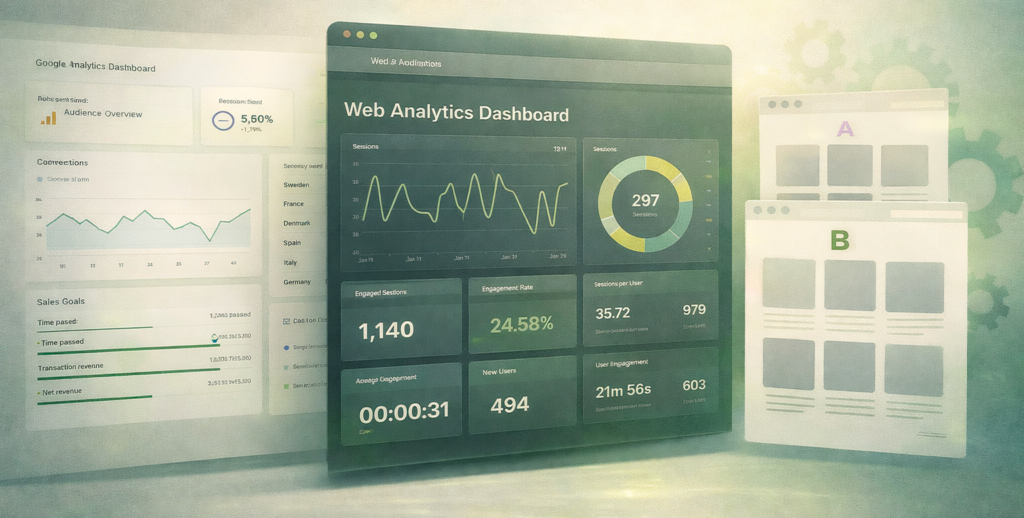
One of the biggest mistakes you can make is not to install an analysis tool. Without data, you don't know how many visitors are coming to your site, where they're coming from, or which pages are really performing.
Google offers a reference tool for analyzing this data: https://analytics.google.com/
Testing a title, button, layout or value proposition can significantly improve performance. It's often simple adjustments that have the greatest effect.
A site left unattended becomes static. But the market is evolving. Behaviors change. Competitors adapt. Without regular optimization, you'll fall behind without even realizing it.
Launching a site is not the end of the work. It's the beginning of a process of continuous improvement. Those who understand this logic transform their site into an engine for growth. Others are content with a passive online presence.
9. Copy competitors instead of positioning yourself
It's healthy to observe your competitors. Copying them, on the other hand, is a strategic mistake.
Many companies analyze the leading sites in their sector to «do the same». Same structure. Same pitch. Same promise. The result is predictable: an interchangeable site with no strong identity.
In a saturated market, differentiation is an essential lever. The Harvard Business Review has long emphasized the importance of positioning and brand strength for sustainable differentiation.
Copying a competitor means accepting their strategic framework. It means entering the competition on the same criteria, often without any distinctive advantage.
Conversely, in-depth work on positioning clarifies your target, your core promise and your unique angle. This reflection directly influences the site's architecture, editorial tone and calls to action.
This is precisely the role of a Strategic coaching 1:1 VINADOU The aim is to help managers structure their offer, refine their message and build a site aligned with a clear vision.
Without positioning, a site remains a generic showcase. With strong positioning, it becomes a powerful differentiation tool.
10. Believing that a professional website is too expensive
The perception of cost is often misjudged. Many entrepreneurs see the creation of a site as an expense to be minimized.
The real question is not: « How much does a professional website cost?«
The real question is: « How much does an ineffective site cost me?«
A poorly designed site loses credibility. It reduces conversions. It hinders SEO. It drives away qualified prospects.
These losses are invisible, but very real. They accumulate every month.
A site structured as a strategic asset, on the other hand, generates opportunities. It works continuously. It supports business development.
The 6 possible solutions according to your profile
Depending on your situation :
🔎 You already have a website → Strategic audit
🚀 Want a premium turnkey website → 2026 Creation Pack
🎓 You want to learn → Complete training
🔄 You want to secure and optimize → Ongoing maintenance
🧠 You want to clarify your strategy → Coaching 1:1
📦 You want a structured shortcut → Download premium toolkit
Conclusion
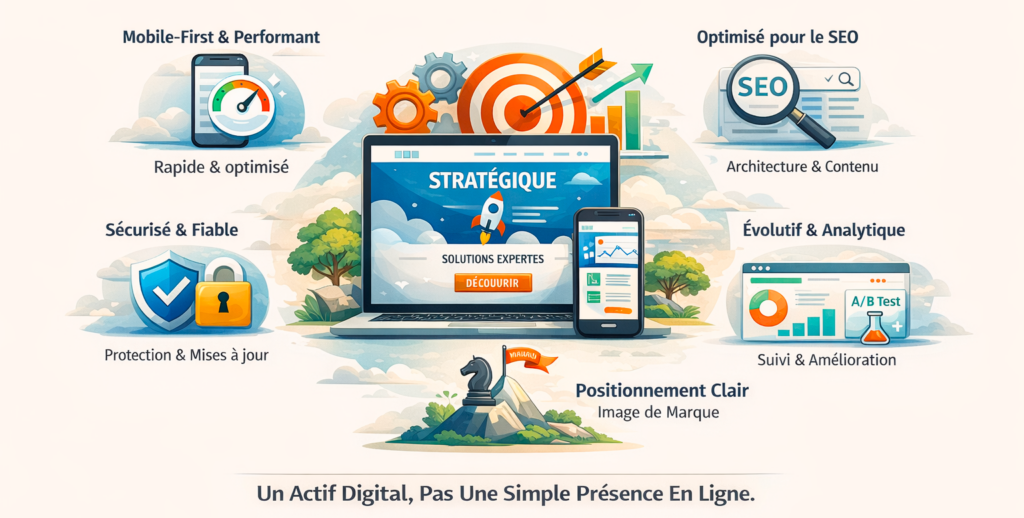
In 2026, a business website is no longer just an online presence. It must be thought of as a strategic lever. Every element - structure, design, content, performance - must serve a clear business objective.
An effective site is designed mobile-first. It's fast, fluid and pleasant to use. It respects current technical standards and meets search engine requirements.
It is also optimized for SEO from the outset. Its architecture is logical. Its content responds to precise search intentions. It attracts qualified rather than random traffic.
Safety is an integral part of its credibility. Updates are tracked. Data is protected. Good practices are applied on an ongoing basis.
A professional site is also scalable. It is analyzed, improved and optimized regularly. It adapts to market changes and user behavior.
Finally, it is differentiating. It reflects a clear positioning and an assertive value proposition. It doesn't copy. It affirms.
This type of site is not a one-time expense. It's a digital asset. It supports growth, reinforces brand image and generates opportunities on an ongoing basis.
The real mistake isn't not having a site.
The real mistake is to have a site that doesn't work for you.
 French
  English